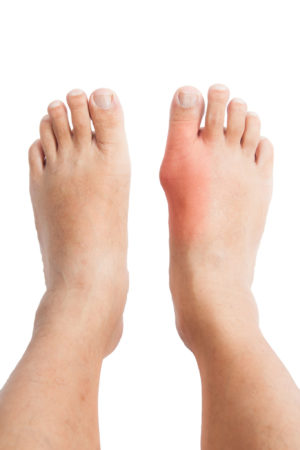
 Gout is an inflammatory condition that can affect joints throughout the body, but the most common area for it to rear its ugly head is in your feet. The condition develops when uric acid, which is typically produced and excreted by your body as waste, ends up staying in your bloodstream and eventually crystallizing in your joints. These acid crystals then irritate soft tissues in and around the joint, causing them to inflame and become tender or painful.
Fortunately, most patients can effectively manage uric acid development with conservative treatments like exercise, dietary improvements and overall lifestyle changes. However, in severe cases, the problem may be addressed with a surgical procedure. In today’s blog, we take a closer look at how gout may be surgically managed.
Surgical Management Of Gout
As we noted above, the vast majority of gout cases can be addressed with the help of conservative treatments. Exercise can help your body better get rid of this buildup, dietary improvements can ensure less uric acid builds up in your bloodstream, and medications can also help your body better rid itself of the acid. Even when a gout attack is extremely painful, oftentimes symptoms eventually subside and conservative treatments can help normalize uric acid levels going forward.
However, for a small percentage of gout sufferers, they will be unable to find relief through conservative care, and their symptoms will remain quite debilitating. In these instances, surgery may be recommended. Depending on your specific circumstances, a few different surgical methods may be considered, including:
Crystal Removal – If large uric acid crystals have developed and conservative methods aren’t helping them dissipate, a “tophi removal” surgery may be ordered. Tophi is the medical classification for the large chunk of uric acid that has developed around the joint area. If these nodules remain large, or they break open and become infected, surgery to remove the crystal may be necessary.
Joint Fusion – If the gout buildup has done so much damage that the joint can no longer comfortably function, a joint fusion procedure may be recommended. Fusing the joint together will limit movement at the joint, and it’s movement that is causing symptoms to develop. Fusion limits painful joint movement, but without other lifestyle changes, uric acid could continue to build up in other joints.
Joint Replacement – If the joint has become so damaged as a result of the uric acid crystals, the affected joint may be replaced. The affected joint pieces will be removed and replaced by artificial components to mimic the motion of a healthy joint. Similar to a joint fusion, it’s important to also pursue other conservative methods to limit uric acid buildup so problems don’t develop in other joints.
We’re confident that we can help you overcome your gout issue before it progresses to the need for surgery, but at the same time, we’ll perform a procedure should it reach that point. One way or another, we’ll help you find relief. For more information, reach out to Dr. Silverman by filling out this contact form.