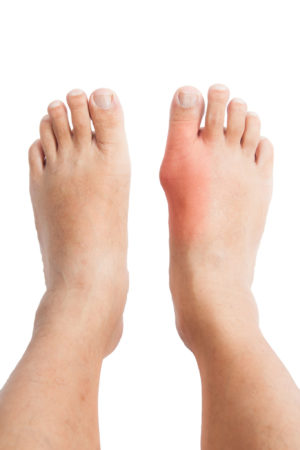
 Gout is a foot condition that we’ve talked about more than a few times on this blog. It’s an incredibly common condition, estimated to affect about 12 million people in the United States. Regular exercise and an improved diet can help to calm gout flareups, but one oft-overlooked aspect of gout management is your liquid intake. Staying hydrated can be very helpful in overcoming a flareup or keeping gout at bay, and in today’s blog, we explain why that’s the case.
Hydration And Gout Management
Before we dive into why hydration is important if you are working to prevent or treat gout, let’s first explain why the condition develops. Gout is caused by a buildup of uric acid in your bloodstream. Uric acid can build up when your body breaks down a substance known as purines.
Purines are molecules that are found in all living cells, and you take in about one-third of the purines in your body through your diet. These purines are metabolized through your digestive system and turned into uric acid, which is then processed by your kidneys and excreted through your urine. Problems occur when your purine intake outpaces the rate at which your kidneys can break down and expel them. This leads to extra uric acid buildup in your bloodstream, and these uric acid crystals are what agitate soft tissues in your big toe joint, leading to a gout flareup.
Now that we understand the role that your kidneys play in preventing uric acid buildup, it’s easier to see how our liquid intake has an impact on our ability to manage gout. Staying hydrated is key for optimal kidney function. Water helps your kidneys remove waste through urine, and it also keeps our blood vessels open, allowing for easier filtration. That’s not so say that you can simply slam a liter of water during a gout flareup and assume everything will be back to normal after you’ve gone to the bathroom, but staying hydrated is a key component to adequate uric acid removal. Similarly, eating a healthy diet can limit the amount of purines in your system, while regular exercise can make it easier for uric acid to work its way out of the bloodstream.