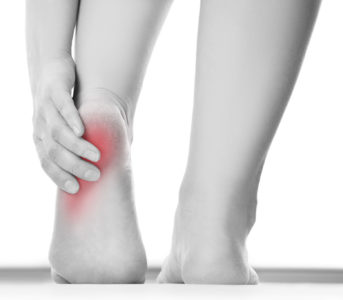
 For many people, the first point of contact with each step they take is their heel. Our heels handle an immense amount of strain each and every day, and while the act of walking is unlikely to overload them, if you fall from a great height or are involved in a car crash, oftentimes it’s your heel that bears the brunt of this acute stress. In these instances, it’s common for part of the heel bone – the calcaneus – to fracture.
Although each individual fracture will be unique, calcaneus fractures tend to be grouped into one of two types of fractures. In today’s blog, we take a closer look at each type of heel fracture and discuss how each is typically treated.
The Two Types Of Calcaneus Fractures
Your calcaneus is the large bone that forms the foundation of the rear part of your heel. It connects with the talus and cuboid bones, and this connection forms the subtalar joint, which is a crucial joint for a variety of foot functions. The calcaneus is oftentimes compared to a hard boiled egg, in that a softer middle is protected by an thin outer shell. Excess trauma to the heel can cause this protective layer to break and a larger section of the bone to collapse and fragment. Fragmented bones and potential damage to an important joint mean that these heel fractures can be quite severe.
When a calcaneus fracture occurs, it typically develops in one of two forms. There is the intra-articular fracture and the extra-articular fracture, and we’ll take a closer look at both.
Intra-Articular Calcaneus Fracture – An intra-articular calcaneus fracture is the more severe of the two types of fractures. Not only does it involve a fracture of the calcaneus, but there is also damage to surrounding cartilage and the subtalar joint. Essentially, not only is the bone itself fragmented and damaged, but so are nearby areas that serve as crucial joint junctures and surfaces. These areas are unlikely to heal ideally on their own, which is why surgery is more common for the intra-articular calcaneus fracture.
Extra-Articular Calcaneus Fracture – An extra-articular calcaneus fracture is a fracture that does not involve damage to nearby joints or joint surfaces. This type of fracture can be the result of an avulsion injury (where a piece of bone is pulled off the calcaneus), or due to repetitive stress and overuse, like what an athlete or amateur runner might experience as they increase their workload. The majority of extra-articular heel fractures can be managed with the help of conservative treatments like rest, activity avoidance, physical therapy and a gradual return to higher impact activities, but some will still need to be addressed with a surgical procedure depending on their severity or how well they respond to non-operative treatment.
When surgery is necessary, it’s oftentimes performed using what’s known as the ORIF technique, which stands for Open Reduction Internal Fixation. The surgeon will use hardware like plates and screws to reposition bone fragments and secure them in place so that healing can occur as planned. You’ll then remain non-weight bearing for weeks while healing begins to run its course. Eventually you will transition to partial weight bearing and physical therapy around the 8-week month, and many patients are back to normal daily activities by around three months post-op. That said, severe fractures and more ambitious surgeries may require the patient to progress through a more extensive rehabilitation period, and maximum recovery may take anywhere from six months to two years to acheive.
For more information, reach out to Dr. Silverman by filling out this contact form.