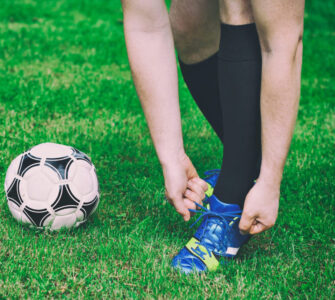
 The World Cup soccer tournament came to a close yesterday as Spain defeated Argentina 1-0 in the final, and overall the tournament was viewed as largely successful. All of the big name superstars played well in the tournament, and there were very few major injuries in the newly expanded 48-team tournament. However, soccer is a major source of foot, ankle and knee injuries among youth athletes, and researchers are always looking for new ways to cut into this injury risk. Some believe that improved equipment could drastically lower this injury risk.
One group of researchers is looking for volunteers to partake in a new study that examines if “next-gen” cleats could help reduce lower body injuries in athletes. The group is focusing on cleats because a fair amount of soccer injuries occur when a foot is subjected to a significant amount of force when it is planted and twisting in the ground. Cleats are designed to grip the ground and prevent slipping and sliding on the field, but when a cleat gets stuck in the ground because of this enhanced traction, stress is pushed upwards from the foot to the ankle and knee. It’s this upline force that is responsible for tens of thousands of ACL injuries each year.
Next-Gen Cleats
Researchers have designed a new cleat where the studs on the bottom of the shoe can bend 12 degrees in any direction. This ability to bend in different directions should in theory greatly decrease the rotational friction or torque experienced by the foot. By decreasing and spreading out this force, feet, ankles and knees should be less likely to be overloaded and fail as a result of excess stress.
The study is still in the initial phases, but it will be interesting to track in the coming months. In theory, alleviating this acute moment of stress should help prevent catastrophic injuries, but it’s unlikely to be a perfect science. Many world class athletes are very particular about their cleats because they view them as an extension of their feet. These athletes rely on incredibly precise movements and need to strike the ball perfectly to curl it past a goalie and into the net or to feed a cross to a charging teammate.
If components on the underside of the cleat are more prone to motion, this stud flexibility can add a layer of unpredictably to the equation. Your plant leg could shift ever so slightly as you prepare to strike the ball, or perhaps you can’t get as much force behind a kick because of the ever-so-slight shift of the studs as you gear up to kick. That could, in theory, be the difference between finding the back of the net and sailing a ball over the crossbar.
We’ll see what the injury data says before we theorize any further, but at lower levels of play, these cleats certainly could reduce injury rates if they offload forces as hoped. We’ll keep tabs on the study as it unfolds, and as always, connect with Dr. Silverman if you’re working your way back from a soccer injury or are dealing with lingering instability in your ankles!