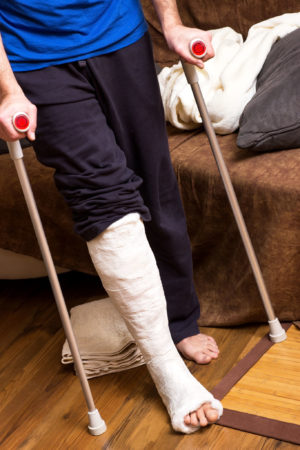
 If you’ve undergone foot or ankle surgery, there’s a good chance that your surgeon will recommend that you be non-weightbearing or limited weightbearing for a short period of time after the procedure. Following this advice is essential to your recovery, but we understand that being non-weightbearing on one of your feet can be quite challenging as you attempt to go about your day. In today’s blog, we share some tips for succeeding in your quest to remain non-weightbearing as recommended after your foot surgery.
Why Non-Weightbearing?
Your surgeon can go into greater detail as to why it’s important not to bear weight through your surgically-addressed foot, but oftentimes this advice is given because:
Incision Recovery – Surgical wound sites typically heal better when they are not stressed by the weight of your body. Specifically, Achilles tendon repair incision sites and some foot fracture repair incisions are much more likely to close optimally if they are not regularly burdened by the stress of your body weight.
Bone Healing – If fractures have been reset or bone has been intentionally altered during the course of the procedure, it will take time for the bone to fuse together and solidify. New healthy bone cells can repair a site more easily without the area being stressed by the weight of your body.
Hardware Positioning – Any surgical hardware that has been inserted is strong and capable of handling a fair amount of stress, but it’s not ready to handle this stress right away. Hardware can shift or break if the structure or supportive bones and tissues are overloaded with stress during the early stages of healing.
Surgical Failure – Perhaps the most important reason to avoid being weightbearing after specific surgeries is to avoid the possibility of causing the repair to fail. Soft tissues can tear, bones can fracture or hardware can move out of the proper position, causing the operation to be for naught.
How To Be Non-Weightbearing After Foot Surgery
Here’s what we tell our patients who are looking to avoid potential issues while they are non-weightbearing for a portion of their recovery.
Prepare In Advance – Prepare for this outcome before you head in for surgery. Set up a recovery area in your home that is stocked with essentials like power cords, reading materials, water bottles and other entertainment options so that you’re not scrambling to move around your house on one foot.
Get The Chores Done – Do laundry, vacuum the house, pick up tripping hazards and prepare some healthy meals that are easy to reheat so that you’re not trying to cook, clean or do housework on one foot.
Mobility Aids – Look into different mobility aid options and talk with your doctor to see which might be right for you. A protective boot and a cast are the most common pair, but knee scooters or seated scooters are also options to consider if you may be unsteady or uncomfortable on crutches.
Lean On Others – Let friends and family know that you’ll be a little less mobile for a period of time. Odds are they will be willing to assist where they can. You’d cook a meal or drive a friend to the store, so don’t be surprised if others are willing to help while you’re non-weightbearing after surgery.
Don’t Bear Weight! – This point sounds simple, but you’d be amazed at how many patients say they lost their balance and put weight on their foot because they were trying to do too much, or they did it intentionally because they simply believed their foot was ready to handle some weight. Don’t put weight onto your surgically-addressed foot until you have been given clearance by your surgeon or your care team!
It may not be ideal to be non-weightbearing after surgery, but it’s a short-term issue that will pay off in the long run. If you’re running into any issues while you’re non-weightbearing, reach out to Dr. Silverman or your surgical team for advice. To talk to his team or to schedule an appointment, give Dr. Silverman and the team at OthoArizona a call today at (602) 648-5444.